
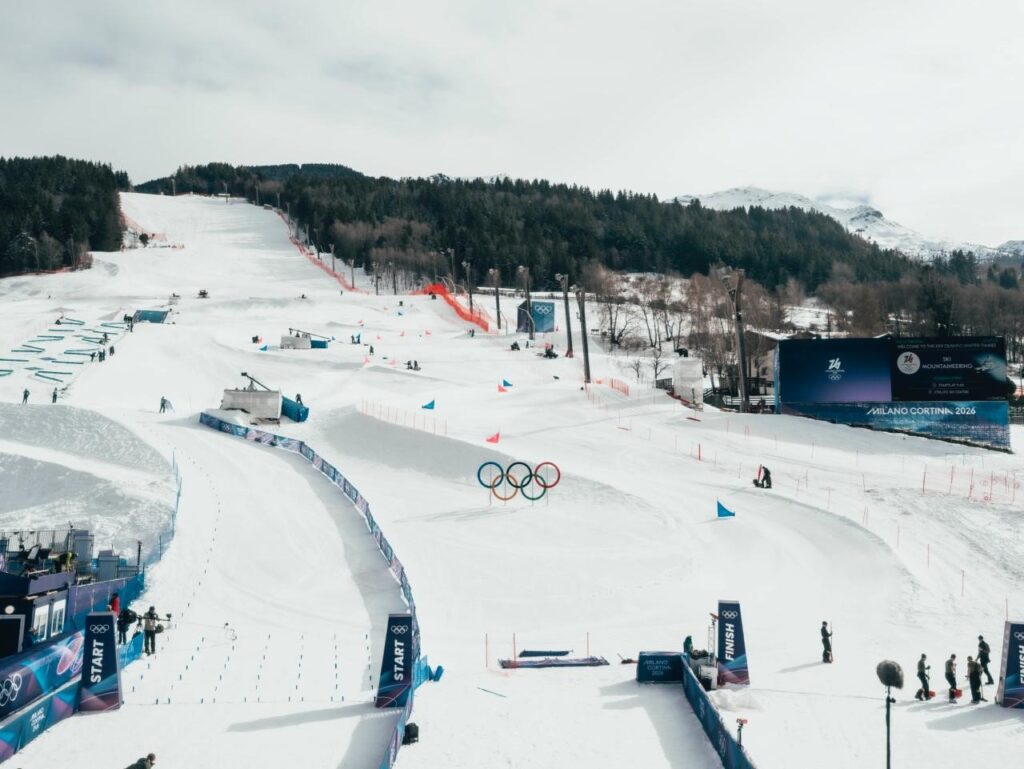
The wait is finally over! After years of anticipation, Ski Mountaineering is stepping onto the Olympic stage for the very first time, and the excitement is palpable. This Thursday, the iconic slopes of Bormio will host the sport’s most explosive and dynamic discipline—the Sprint. Athletes from around the world will push the limits of speed, endurance, and technical skill, racing not just for medals but to etch their names into history as the first-ever Olympic champions in Ski Mountaineering. Fans and newcomers alike will witness a breathtaking spectacle, as every climb, transition, and descent will define the opening chapter of a brand-new Olympic legacy.
In just two days, the alpine skiing venue has been transformed into a dedicated Ski Mountaineering arena and is now ready to welcome the world for tomorrow’s historic debut. Working together with OBS, Omega, MICO, and ISMF, the teams have done an incredible job to ensure a seamless Olympic experience. After yesterday’s parade, you could feel the excitement in the air—teams and communities alike are experiencing that special “butterfly” moment only the Olympics can bring.
Tomorrow, the action begins with the Sprint discipline. A compact and powerful field of 18 women and 18 men representing 14 nations will compete—not just for medals, but to define the first chapter of a new Olympic legacy. The morning will feature qualifying heats, followed by high-pressure semi-finals and finals in the early afternoon, where the first-ever Olympic medals in Ski Mountaineering will be awarded.
Fourteen nations have qualified athletes for this historic debut, highlighting a sport that has expanded far beyond its Alpine roots. Participating countries include: Spain, Switzerland, France, Italy, Norway, Austria, Germany, Poland, Slovakia, Belgium, the United States, China, Australia, and one Individual Neutral Athlete (AIN).
Sprint Race Track
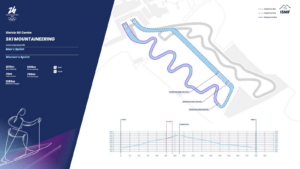
The Sprint competition will take place on a course largely identical to the one used for the 2025 test event, providing a familiar yet grueling layout at the foot of the Stelvio. The track features roughly 70 meters of vertical gain and is designed to challenge athletes for approximately three intense minutes.
From the start, athletes face a steep 100-meter climb leading into the first “diamond” section, where positioning will be critical. The second diamond section follows closely, demanding power and tactical awareness for those looking to gain an advantage. After this, the course transitions to a slightly flatter section with a 10% gradient, before reaching a key 10-meter vertical push—one of the most decisive parts of the track, where gaps are likely to form.
Next, competitors face a 20% slope over a 100-meter section before the final transitions. Skins are removed for the downhill portion, which includes a series of challenging turns, parabolic bends, and jump leading directly to the finish line, where athletes are expected to arrive at high speed.
The Women’s Field: Champions and Comebacks
The fight for the women’s podium is expected to be a clash between established legends and explosive new talents. France’s Emily Harrop enters as arguably the most dominant figure in the sport’s recent history, carrying four consecutive Overall World Cup titles into these Games. Her primary rival will be Switzerland’s Marianne Fatton, the 2025 Sprint World Champion, who has spent her career perfecting the technical transitions that define this format.
While these veterans are the favorites, the emotional heart of the race belongs to Spain’s Ana Alonso Rodriguez, who remarkably returned to the top ten of the World Cup just months after a devastating training accident in September 2025.
They will be joined by strong contenders like Italy’s Giulia Murada, who knows these mountains better than anyone , and USA’s Anna Gibson, a former track star who stunned the field with a World Cup win in her debut season. Other athletes to watch include uphill powerhouse Ida Waldal from Norway , Austria’s most decorated athlete Johanna Hiemer , and Spain’s Maria Costa Diez, who is looking to upgrade her 2020 Youth Olympic gold to a senior Olympic medal.
The Men’s Field: A Technical Showdown
On the men’s side, the race is widely seen as a tactical chess match between the world’s two greatest sprinters. Spain’s Oriol Cardona Coll is the man with the target on his back, a technical master whose 2023 World Title and 14 career World Cup sprint wins make him the gold standard.
Challenging him is Switzerland’s Arno Lietha, a former World Champion and power specialist with 17 career wins.
However, the French squad, led by Overall World Cup champion Thibault Anselmet, is deep enough to sweep the podium.
The field is rounded out by dangerous specialists like Norway’s Hans-Inge Klette, Belgium’s powerhouse Maximilien Drion du Chapois , and Austria’s climbing ace Paul Verbnjak. Younger talents like Ot Ferrer (Spain) will also look to disrupt the podium after proving their speed on the youth circuit.
The Women’s Field: Champions and Comebacks
The mountain environment is expected to play a major role. Forecasts for Thursday indicate wet conditions with falling snow, making transitions particularly tricky. In a discipline where races are won or lost in seconds, efficient skin removal and quick clipping into bindings could prove decisive.
The morning heats will whittle the world’s elite down to the fastest six for the finals. Set your watches (all times CET):
- 09:50 h: Women’s Heats
- 10:30 h: Men’s Heats
- 12:55 h: Women’s Semifinals
- 13:25 h: Men’s Semifinals
- 13:55 h: Women’s Final
- 14:15 h: Men’s Final