The heavy snowfall that defined Thursday’s sprint races in Bormio has cleared, leaving a pristine and high-stakes stage at the Stelvio Ski Centre for the final act of ski mountaineering’s Olympic debut. On Saturday at 13:30h, the quiet of the Bormio mountains will be replaced by the frantic energy of the Mixed Relay, a discipline that shifts the spotlight from individual brilliance to national performances. Following the historic victories of Switzerland’s Marianne Fatton and Spain’s Oriol Cardona Coll, the focus now turns to which country can best navigate the tactical track of the relay to secure a place in the record books.
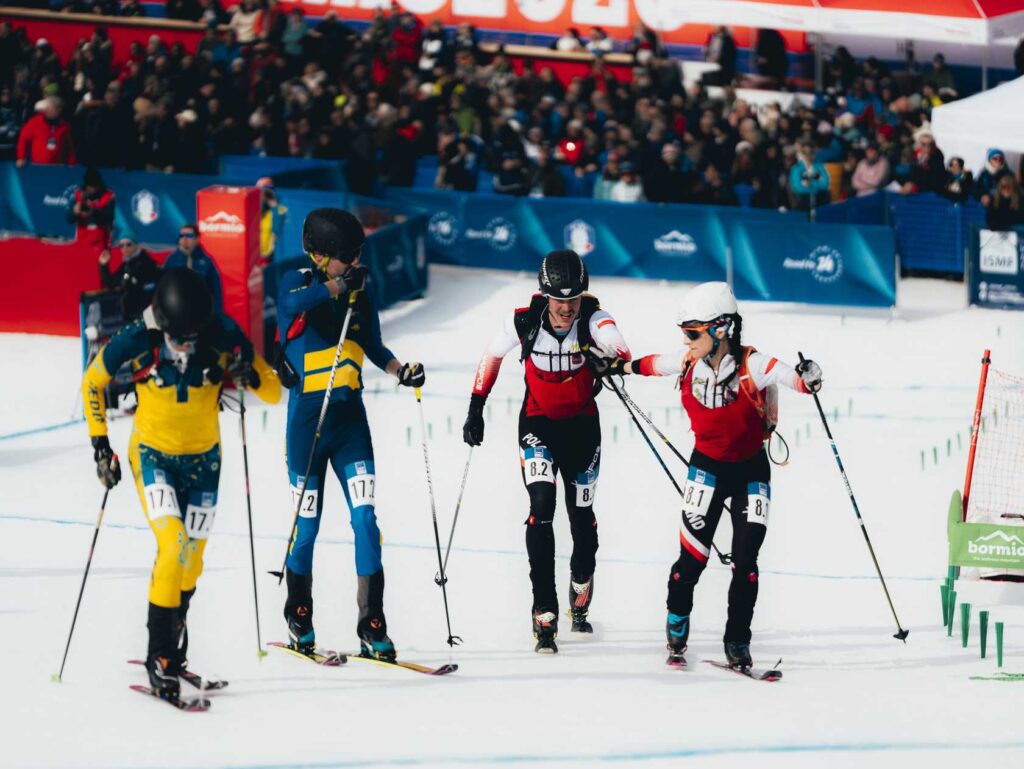
The Mixed Relay is perhaps the most spectator-friendly format in the sport, designed for high-intensity shifts and rapid-fire changes. Each team consists of one woman and one man representing the same National Olympic Committee, who must complete the circuit twice each in a predetermined Woman-Man-Woman-Man order. The race is a relentless 30-minute sprint where every second in the transition zones counts. Athletes must skins-up for a grueling climb, transition to a foot section where they carry their skis on their backs to scale the now iconic Bormio steps, and then rip their skins off for a high-speed descent back to the handover zone. The exchan
ge itself is a moment of pure pressure, requiring a physical hand-touch in a designated zone before the next teammate can explode onto the course.
The battlefield for the Mixed Relay at the Milano Cortina Winter Olympics remains the lower slopes of the legendary Stelvio, with the course starting and finishing at 1200 metres. While the vertical gain on each round will be 135m, which may seem modest to elite climbers, the explosive nature of the relay means athletes will be racing at their absolute aerobic limit. The technical diamond section and the slippery mountain steps will likely be the deciding factors, as seen during Thursday’s sprints where small errors in these zones cost many athletes their podium dreams.
Mixed Relay Race Track
The Mixed Relay competition will take place on a course largely identical to the one used for the 2025 test event, offering a familiar yet demanding layout at the foot of the Stelvio. The track features approximately 135 meters of vertical gain and is designed to challenge athletes for around 30 intense minutes.
From the start, athletes face a steep 50-meter climb, leading into a small flat section of about 60 meters. They then continue on a straight climb of roughly 80 meters to the first transition. The first descent features parabolic turns and technical complexity, bringing athletes to the second transition. Exiting the transitions quickly, competitors enter the “diamond” section, where positioning will be critical.
The second diamond section follows closely, demanding both power and tactical awareness for those aiming to gain an advantage. The course then transitions to a slightly flatter section with a 10% gradient before reaching a key 10-meter vertical push—one of the most decisive parts of the track, where gaps are likely to form.
Next, competitors tackle a 20% slope over a 100-meter section befor
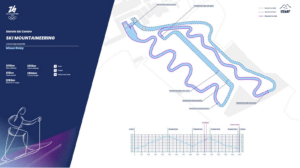
e reaching the final transitions. Skins are removed for the downhill portion, which includes a series of challenging turns, parabolic bends, and jumps, leading directly to the finish line. Athletes are expected to arrive at high speed, put their skins back on at the last transition, and hand off to their partners.
In the Mixed Relay, maintaining a steady pace and executing all six transitions per loop efficiently will be crucial to winning the race.
Athletes to watch
The battle for the top step of the podium is widely expected to be a high-speed duel between France and Spain, two nations that have established a stranglehold on the sport by claiming every World Championship, European Championship, and many World Cup titles, over the last two seasons. France arrives with a daunting lineup in Emily Harrop and Thibault Anselmet, both multi-time World Cup overall winners who are fresh off their own individual Olympic podium finishes on the Stelvio. They are countered by a solid and reliable Spanish squad led by the newly crowned Olympic champion Oriol Cardona Coll. Paired with Ana Alonso Rodriguez—whose bronze-medal performance just 14 weeks after a major knee injury has become the story of the Games—the Spanish team possesses a combination of pure technical dominance and psychological resilience.
While Switzerland remains a primary threat with individual gold medalist Marianne Fatton and the explosive Jon Kistler, the recent history of the sport suggests that the road to Olympic glory must go through the French and Spanish powerhouses.
The depth of the twelve-nation field ensures that no team can afford a single mistake. Italy will be looking for redemption on home snow with Alba de Silvestro and the veteran legend Michele Boscacci leading the charge for the Azzurri.
Also fighting for the podium positions will likely be the technically proficient Austrians, Johanna Hiemer and Paul Verbnjak, and the German pair of Tatjana Paller and Finn Hösch, both of whom showed impressive speed in the individual heats at the sprint race.
The United States remains a dark horse following a historic World Cup win last season by Anna Gibson and Cameron Smith, a result that proved the Americans can compete with the traditional Alpine powers. Norway brings the uphill strength of Hans-Inge Klette and the young sensation Ida Waldal, while China relies on the burgeoning talents of Bu Luer and Yuzhen Cidan.
Poland’s Iwona Januszyk and Jan Elantkowski, Slovakia’s Marianna Jagerčíková and Jakub Šiarnik, and the Australian duo of Lara Hamilton and Phillip Bellingham complete the twelve teams taking the start.
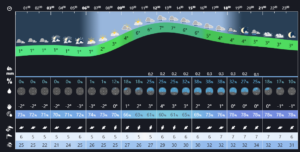
Weather Conditions
As the sun sits high over the Stelvio on Saturday afternoon, these twenty-four athletes will fight not just for themselves, but for the honor of being the first nation to stand atop an Olympic Mixed Relay podium in ski mountaineering.