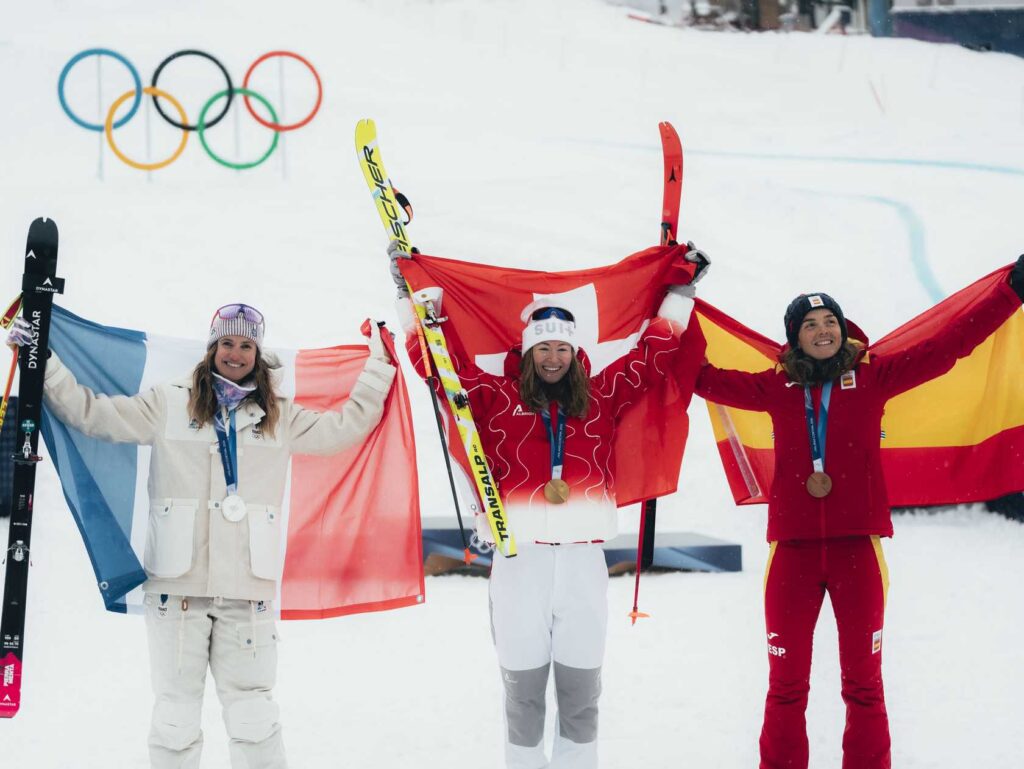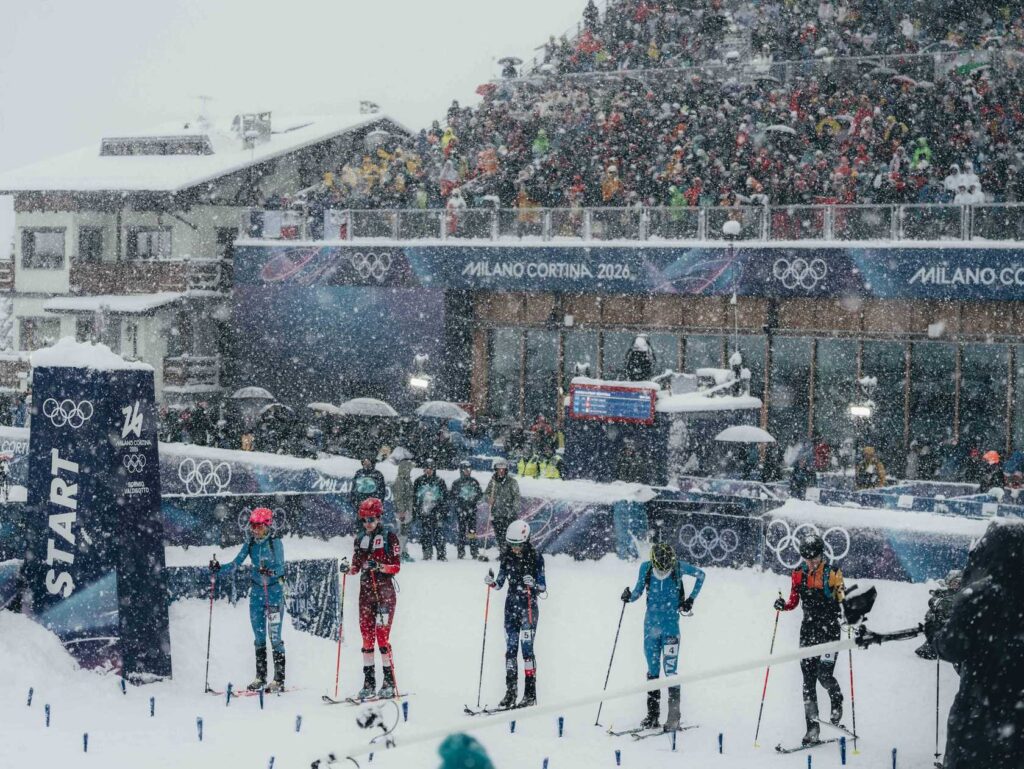
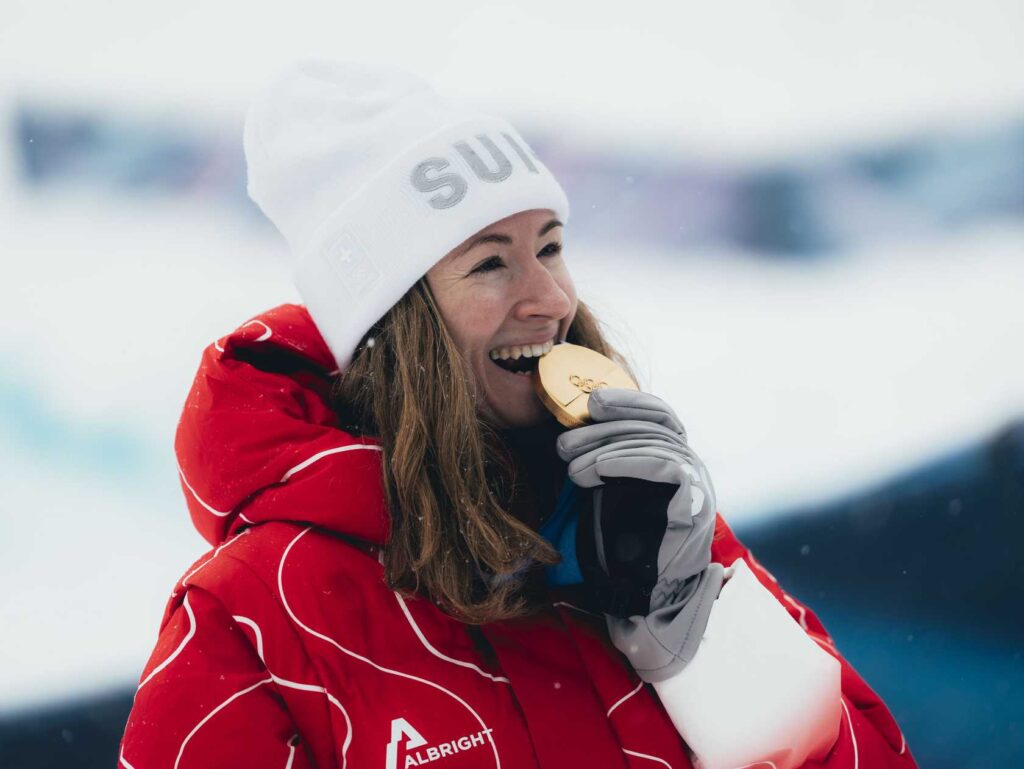
Bormio witnessed a watershed moment for winter sports on Thursday. Amidst heavy falling snow on the legendary Stelvio slope, Switzerland’s Marianne Fatton etched her name into the record books as the first-ever Olympic champion in ski mountaineering. In a high-stakes women’s sprint final at the Milano Cortina Winter Olympics that lived up to the immense pre-race hype, Fatton fended off her long-time rival and favorite Emily Harrop to clinch the gold in 2:59.77. Spain’s Ana Alonso Roddriguez claimed an epic bronze medal just 4 months after an accident that left her without an ACL on her left knee.
Talking after the race, Fatton said: “It’s just amazing. The gold medal? I was just hoping for a medal, but the gold medal? I was already happy that we could live this moment, it’s history for our sport and for us as athletes. To be able to compete in this race was just amazing and very happy to just live this.”
Fatton’s victory was a masterclass in precision and tactical patience. While France’s Harrop had looked nearly untouchable during the morning qualifiers—dominating both her heat and her semi-final with clinical ease—the final came down to the “diamond” section and the transitions, those high-pressure seconds where Skimo races are won and lost.
Harrop led early, but the race shifted dramatically during the second transition. Fatton seized the lead with a lightning-fast “skins-off” maneuver, exiting the uphill section with a slim advantage that she defended with a brave, aggressive line down the snowy descent. Harrop crossed the line just over two seconds later to take a hard-fought silver (+2.38).
However, the race for the final podium spot produced what is already being called one of the most remarkable stories of the Milano Cortina Games. Spain’s Ana Alonso Rodriguez claimed the bronze (+10.45), a result that seemed medically impossible just months ago. Only 14 weeks prior to standing on the Olympic podium, Alonso Rodriguez was hit by a car during a training session, resulting in a torn ACL in her left knee. Rejecting immediate surgery to keep her Olympic dream alive, she relied on pure grit and flawless descending technique to battle through the field. Hovering between fourth and fifth for much of the uphill, she delivered a flawless final transition to move into third, holding off Germany’s Tatjana Paller in the final stretch. It marks only the sixth Winter Olympic medal in Spanish history—and a powerful testament to the athlete’s resilience.
The path to the final was a gauntlet that tested the world’s elite. The first semi-final turned into a “Group of Death,” featuring the three eventual medalists and Norway’s teenage sensation Ida Waldal, who progressed as a lucky loser. The intensity of that first heat was so high that its pace far outstripped the second semi-final, which saw France’s Margot Ravinel and Germany’s Paller move through, while home favorites Giulia Murada and Alba de Silvestro saw their podium ambitions end prematurely in front of a disappointed but supportive Italian crowd.
The Heats
The road to the historic final was paved with three intense preliminary heats where 18 elite athletes from around the world vied for progression. In Heat 1, Emily Harrop set the tone with a commanding win, followed by Germany’s Tatjana Paller and Spain’s Maria Costa Diez, while Marianna Jagercikova (SVK), Johanna Hiemer (AUT), and Lara Hamilton (AUS) also tested their limits on the 725-meter track. Heat 2 saw Marianne Fatton demonstrate her speed early, leading a group that included home favorite Giulia Murada, Margot Ravinel (FRA), and Alba de Silvestro (ITA), with Helena Euringer (GER) and Iwona Januszyk (POL) completing the lineup. The final heat featured Ana Alonso Rodriguez squaring off against Swiss talent Caroline Ulrich, Norway’s Ida Waldal, and Anna Gibson of the USA, alongside Cidan Yuzhen (CHN) and Rebeka Cully (SVK), who battled through the snowy conditions at the Stelvio Ski Centre.
The competition intensity peaked during the two semifinals, which narrowed the field to the final six. The first semifinal was a tactical battle where Harrop again claimed the top spot, narrowly beating out Alonso Rodriguez and the young Swiss Caroline Ulrich. Meanwhile, Ida Waldal, Anna Gibson, and Maria Costa Diez saw their individual podium hopes fade despite valiant efforts. In the second semifinal, the racing was equally fierce; local standout Giulia Murada took the heat win ahead of Fatton and Tatjana Paller, who both secured direct qualification to the final. This heat also marked the end of the Olympic journey for Margot Ravinel, Alba de Silvestro, and Marianna Jagercikova, setting the stage for the dramatic showdown that would crown the first-ever Olympic Skimo champion.
As the snow continued to blanket Bormio, this inaugural final proved that ski mountaineering belongs on the world’s biggest stage. It offered everything the Olympic movement prizes: epic races, mountain environment and technical brilliance, and a storied underdog performance. For Marianne Fatton, the gold medal is the ultimate coronation of a career spent at the pinnacle of the sport—now officially recognized under the Olympic rings. For the sport of Skimo, it was a debut that surely left a lasting impression on the global audience.